

Meditación de audio:
https://annikakappner.bandcamp.com/track/ar-ati
Meditación de audio 2:
https://annikakappner.bandcamp.com/track/liquid-dreams
About
“Can we hypothesise the connection between the expansion of the infosphere… and the crumbling of the sensory membrane that allows human beings to understand that which cannot be verbalized, that which cannot be reduced to codified signs?”
-Franco (Bifo) Berardi, After the Future
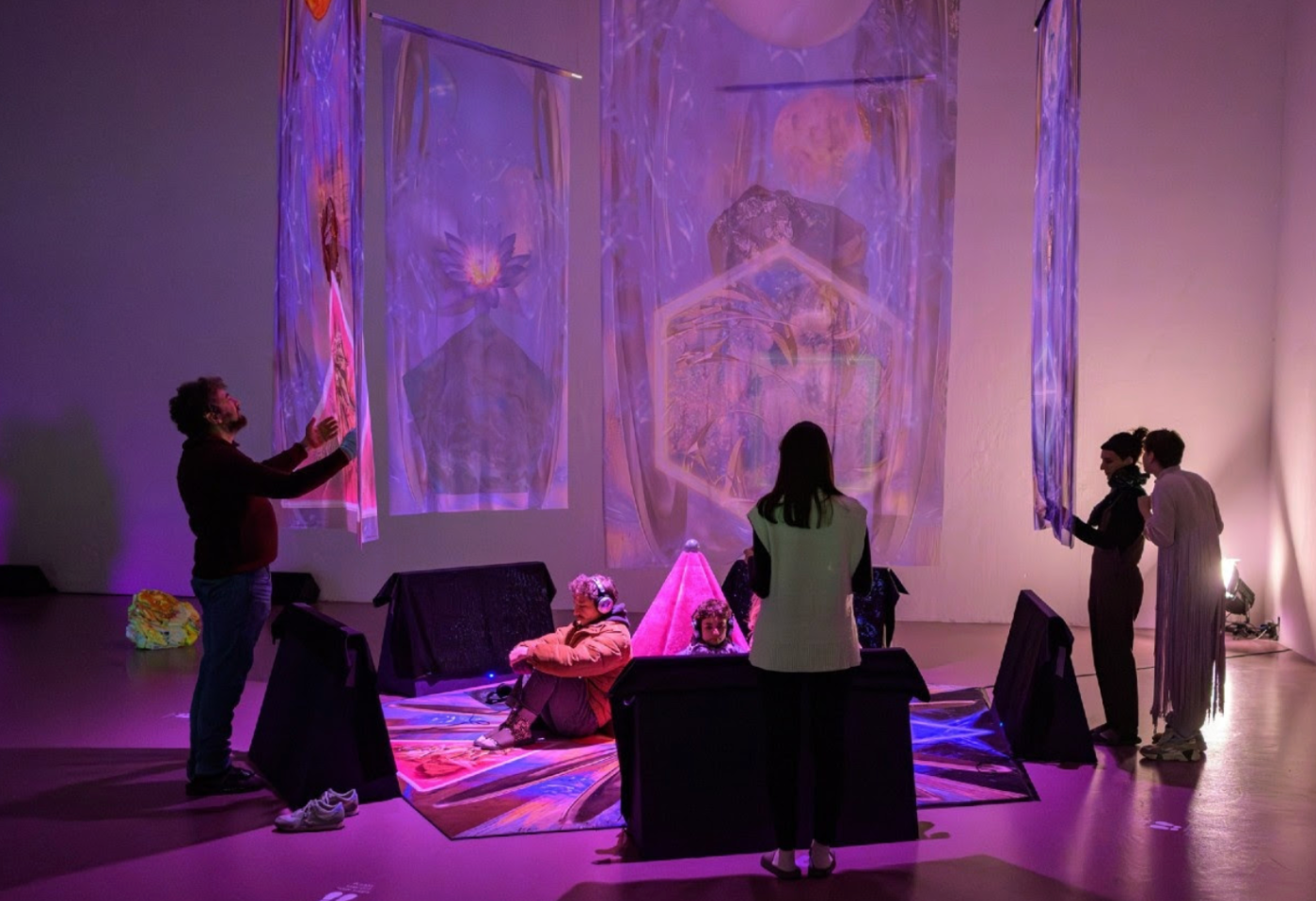
Deep Planetary Sensing is a participatory and collaborative research project, consisting of immersive installations, performances, soundwalks, guided meditations, workshops and this digital platform. It encourages our reconnection with our individual and collective bodies, and fosters active conversations with GAIA, the planetary body we are part of.
The project researches forms of embodied knowledge in relation to our planet, as mediated by contemporary technologies and related cultural constructs. It proposes to access other ways of knowing and relating with technology and our planet through the somatic (e.g. embodiment). In different chapters, the elements of earth, aether, water, air and fire are explored as entry points to rebalance our individual and collective bodies. Through a participatory research approach, different iterations of the works are developed based on participant feedback gathered during workshops and guided meditation performances.
The project furthers research for “Aquarian Gardens,” a soundwalk exploring more-than-human knowledge commissioned by Het Nieuwe Instituut in 2019.
https://www.deepplanetarysensing.com/
Context
The contemporary crisis in the ecological, economic, political and social realm can be traced back to an economic system and the use of (digital) technologies that prioritise productivity. It is built on – and in turn continuously acknowledges and reinforces – a system of knowledge production rooted in (mathematical) analysis, quantifiable data, and social control that facilitates productivity. These are all capacities directly linked to the visual sense, which has become increasingly dominant overtime, sidelining hearing, touch and smell, and has contributed to the disembodiment of knowledge that defines the contemporary condition.
This system is so omnipresent that, even though we feel the need to think and act differently, it has become almost impossible to act outside of its constraining logic. Fortunately, recent decolonial, post-Anthropocenic, and queering epistemologies have enabled us to imagine other, more equitable and inclusive social, political, technical as well as biological ecologies. My contribution to the transformation of our relationship with the visual/technological is to add our body and all its senses into the equation again. Deep Planetary Sensing seeks to add a somatic dimension to complement these developments and foster healing.
Bio
Annika Kappner (b. Berlin, 1980) is an Amsterdam-based visual artist and researcher. Within the expanded field of painting, Kappner creates sensory scenographies that combine landscape, installation, performance, guided meditation, scent and sound to generate glitches in perception.
Kappner’s multidisciplinary practice explores the interconnected evolution of consciousness and archetypal imagery, as well as its reflection on the shifting perception of (self) image and The Other. The artist’s research approach is participatory and collaborative, intertwining rational analysis and her own background in finance with embodied experience and intuition.
Her work layers experiential perspectives unto the relationship between human, nature and technology, and addresses concepts of non-duality and otherness, to encourage the emancipation of our way of sensing our surroundings.
Kappner’s ongoing and ever-evolving research project Deep Planetary Sensing has been in development since 2019. She is a co-founder of the artist collective Elephants & Volcanoes. Selected exhibitions include: Bienal Internacional de Arte Amazónico (PE), Het Nieuwe Instituut (NL), IMPAKT (NL), Julidans (NL), Marres House for Contemporary Art Maastricht (NL), MBOT, St. Louis (US), National Museum of Natural History, Menton (FR) and Rush Arts Gallery, New York (US).
Resources
- David Abram THE SPELL OF THE SENSUOUS
- AI Now Institute ainowinstitute.org/
- K Allado-McDowell Pharmako AI
- David Attenborough First Life
- Aquarian Gardens AQUARIAN GARDENS SOUNDWALK
- Anne BaringEntire web archive THE DREAM OF THE COSMOS THE MYTH OF THE GODDESS
- Azra Bertrand, Seren Bertrand WOMB AWAKENING
- Marcia Bjornerud Geopedia: A Brief Compendium of Geologic Curiosities
- Erin Blakemore Lithospheric magnetic field
- Federico Campagna TECHNIC AND MAGIC
- CrashCourse Silicon – The Internet’s Favorite Element
- Kate Crawford and Vladan Joler Anatomy of an AI System
- Gabriella Garcia There Is No “Artificial” Intelligence: A Conversation with the Initiative for Indigenous Futures
- Tiokasin Ghosthorse The Lakota View on Water
- Michael Grady Yoga 61 Point Practice
- Donna Haraway STORY TELLING FOR EARTHLY SURVIVAL
- Heartmath Institute Science of the Heart: Energetic Communication
- Lynn Hershman Leeson Teknolust
- Werner Herzog Lo and Behold, Reveries of the connected world Fireball: Visitors from Darker Worlds
- Annika Kappner IMPAKT Disrupt & Reflect, Interview, 2021
- Bruno Latour FACING GAIA
- James Lovelock Novacene, The Coming Age of Hyperintelligence
- Anna Lowenhaupt Tsing, Heather Anne Swanson, Elaine Gan, and Nils Bubandt ARTS OF LIVING ON A DAMAGED PLANET
- Drunvalo Melchizedek Serpent of Light
- Winifred Milius Lubell Baubo
- Christian Manil & Laurent Lichtenstein WATER MEMORY
- Lynn Margulis Lynn Margulis presents GAIA Hypothesis at NASA
- Valentina-Mariana Manoiu To believe the unbelievable
- John Martineau Little book of coincidence in the Solar System
- NASA Jet Propulsion Laboratory Exploding Stars Make Key Ingredient in Sand, Glass
- Astrida Neimanis HYDROFEMINISM: OR, ON BECOMING A BODY OF WATER
- Hugh Newman & all MEGALITH Studies in Stone
- Pauline Oliveros DEEP LISTENING PROJECT
- The Olivine Foundation SMART STONES
- Philip S. Rawson Tantra (Art and Imagination)
- Michael G. Raymer The Silicon Web: Physics for the Internet Age
- Royal Society of Chemistry Chemistry in its element: silicon
- Greg Ruggiero GAIA Theory today
- Victor SchaubergerLiving Water
- Sounds of the ForestSounds of the Forest
- Liv StrömquistFruit of Knowledge
- ThanissaraEarth as a Goddess
 On geomancy and sound
Deja un comentario